Karma:
The Path to Freedom
Karma is often described as a cosmic account: good deeds earn rewards, bad deeds bring suffering. This book questions that story and returns to karma’s meaning as action. Then it asks a deeper question: who is the one who acts?
Sukhi Bhaiya and Anurag Seth explore the “doer”, the witnessing self, and non-duality—the possibility that self and reality are not fundamentally separate. Their central proposition is that freedom begins in recognising what we are, even as work, relationships, and responsibility continue.
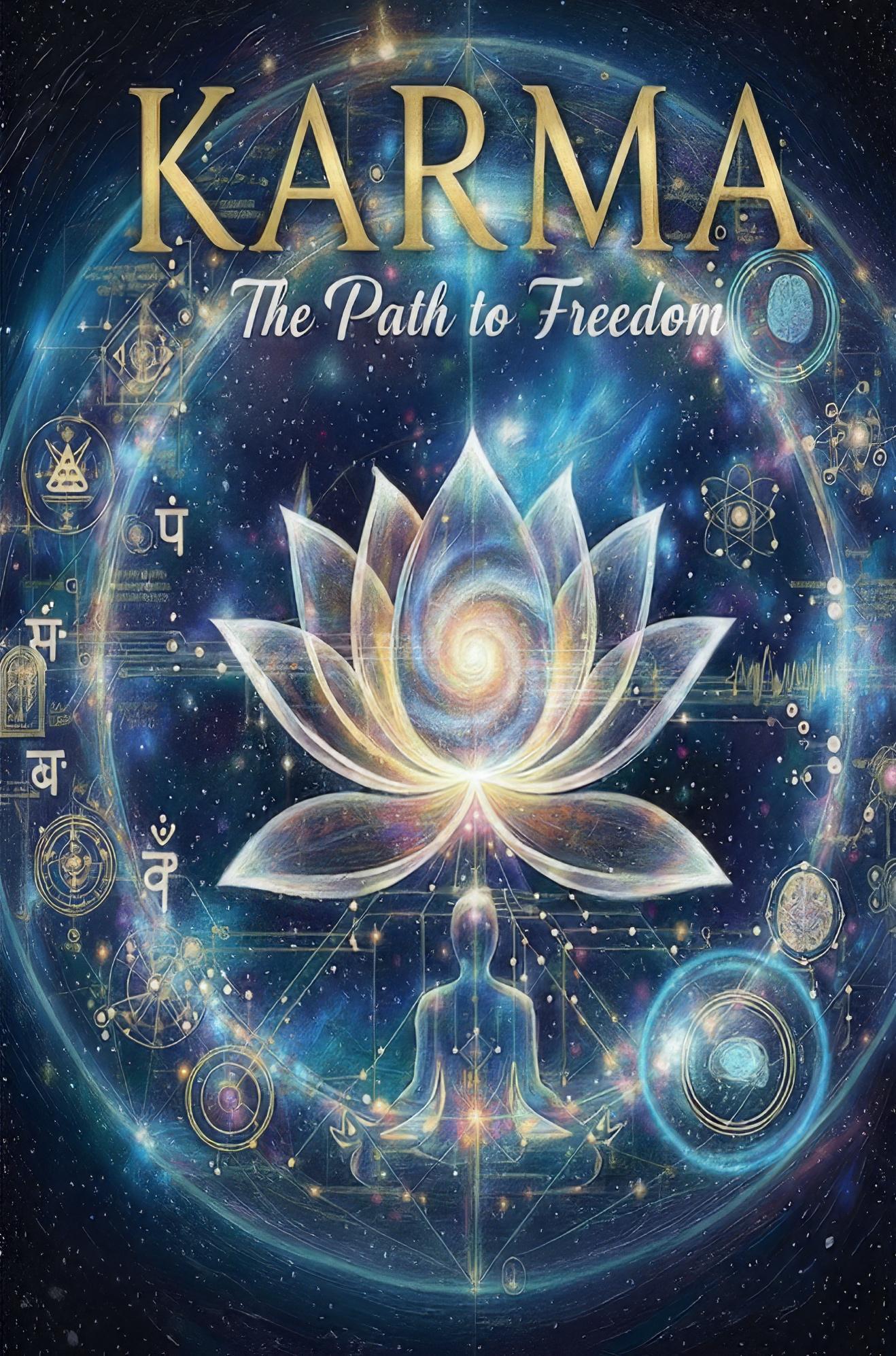
Coming soon
Who is the one
bound by karma?
The prologue calls our reliance on cosmic reward and punishment “the prison of causality”. We try to secure happiness through the right actions, yet every setback invites self-blame and every success brings the fear of losing it. The book asks whether this effort to manage karma keeps the anxious sense of “I” at its centre.
Its inquiry takes several forms: Krishna’s teaching of action without attachment in the Bhagwad Gita; Vasishtha’s insistence on self-effort; Ashtavakra’s invitation to recognise the witness; and Guru Nanak’s Hukam, or divine order. Buddhist, Sufi, and Christian contemplative writings broaden the discussion. The authors explore what these teachings reveal about action, identity, and liberation.
A section on quantum physics and consciousness develops the authors’ philosophical parallels with this inquiry. The final chapters return to self-inquiry, witnessing, and surrender in everyday life. They hold a central tension open: if there is no separate doer, why make an effort? The book’s closing invitation is to consider freedom as recognition, rather than a reward to earn.
Inside the book.
Four parts trace the argument: question the karma model, read the wisdom traditions, examine consciousness and physics, and bring the inquiry into daily life.
The great misunderstanding
What we mean by karma, and what that belief asks us to carry.
The Karma Industrial Complex
When misfortune becomes evidence of bad karma, suffering carries an extra burden of blame. This chapter asks why the promise of cosmic fairness can leave us anxious, judgmental, and afraid to act.
Etymology & Original Context
Karma begins with the Sanskrit word for action. The authors trace the meanings added through interpretation, translation, and cultural habit, asking how action came to mean destiny, debt, or punishment.
The Illusion of the Doer
Watch a thought arise, then ask who chose it. An investigation of the sense of ‘I’ opens a difficult question: can responsibility remain when the idea of a separate controller falls away?
Ancient wisdom
Readings of Hindu, Sikh, Buddhist, Sufi, and Christian teachings on action and freedom.
The Bhagwad Gita Perspective
Arjuna faces a choice in which every path seems painful. Through Krishna’s teachings on action, knowledge, and devotion, the chapter explores how to act when you cannot be sure of the result.
Yoga Vasishtha — The Universe as a Dream
Through Vasishtha’s stories, the world becomes less solid and the self less certain. Alongside this dreamlike view of reality comes a surprising insistence on self-effort, inquiry, and what you do now.
Ashtavakra Gita — The Witness Beyond Action
Ashtavakra asks the seeker to notice the awareness already present beneath changing thoughts and experiences. The challenge is immediate: could the search for future freedom obscure what is here now?
Japji Sahib — Living in Divine Order
What does it mean to accept divine order while still working, raising a family, and serving others? The authors explore Hukam and the possibility of wholehearted participation without the demand for control.
Dhamma — The Buddha’s Path Beyond Self
Everything changes, yet we keep asking people, feelings, and circumstances to make us secure. Buddhist teachings on impermanence, craving, and the absence of a fixed self offer another way to understand suffering.
One Reality, Many Names — Islam and Christianity
Through Ibn Arabi and Christian contemplative writings, the authors explore surrender and divine unity. They draw connections with earlier chapters while considering the distinct languages these traditions use for self and God.
The quantum mirror
The authors’ philosophical reading of physics, observation, and consciousness.
The Measurement Problem and the Quantum Field
Quantum experiments unsettle everyday assumptions about matter and observation. The authors introduce the measurement problem and field theory, then propose philosophical parallels with contemplative ideas about separateness and reality.
Consciousness as the Fundamental Reality
Is consciousness produced by matter, or is it more fundamental? The authors consider competing views and make a philosophical case for awareness as the basis of experience and reality.
Living in freedom
What this means when there is work to do, someone to love, and no guarantee of what comes next.
Embracing Uncertainty — The Only Certainty
Choosing a career, making a promise, planning for tomorrow: life keeps asking us to act without knowing what comes next. This chapter explores decisions made with care and room for uncertainty.
The Practical Path — Inquiry and Dissolution
A deadline brings anxiety, or a partner’s remark stings. The chapter brings self-inquiry, witnessing, and surrender into moments like these, with experiments in noticing reactions before getting carried away by them.
Finally, Arriving at Fundamental Principles of Karma
If there is no separate doer, why make an effort? The authors bring that tension into five principles, connecting their view of action and causality with inquiry, contentment, and freedom.
Not as Destination but Recognition
The closing chapter turns the search back on the seeker. It develops the book’s central claim that freedom is a recognition available in present awareness, even as responsibilities and ordinary life continue.
Summaries of the September 2026 manuscript.
“You can care deeply about the quality of what you produce while recognizing that your fundamental being is not at stake.”
Try a conversation with the book.
Explore karma yoga, the witnessing self, Hukam, or the question of self-effort. The free companion draws on the whole manuscript and links its answers to passages you can read.
Get a note when
the book is out.
Leave your email and we’ll let you know when you can get your copy.